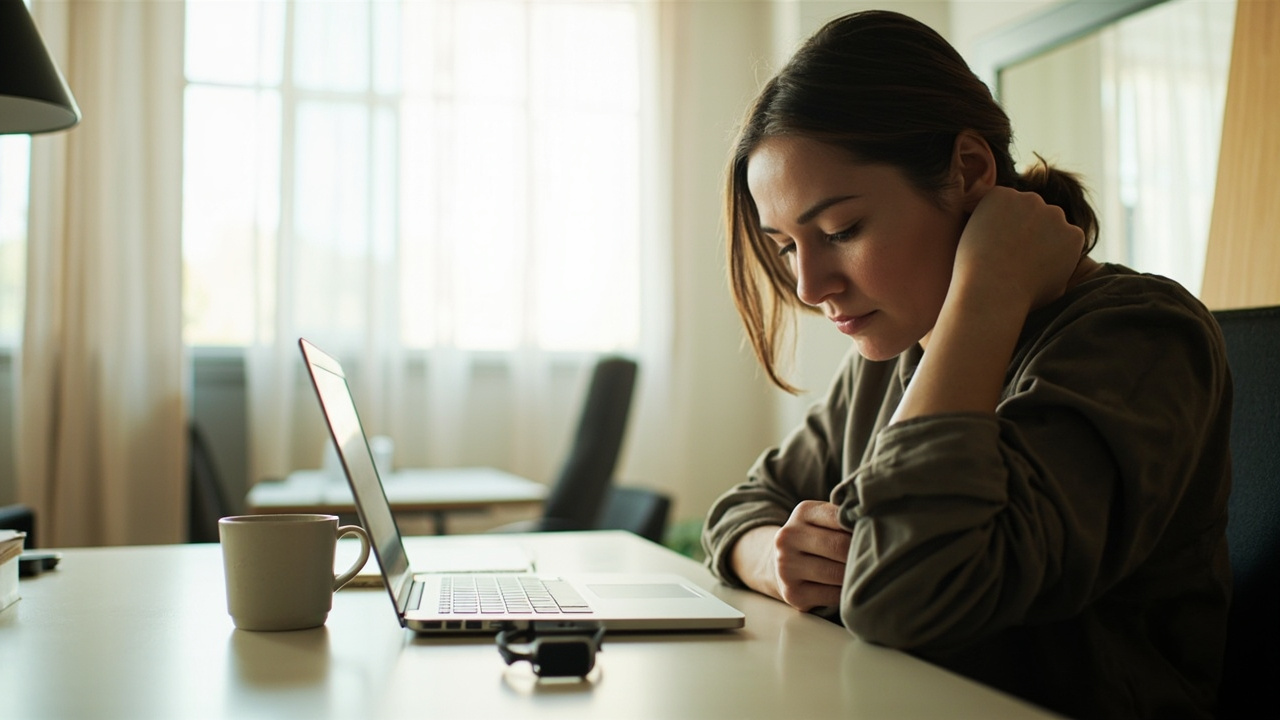
TL;DR: A peer-reviewed analysis of 163 hybrid office workers in Ireland, Slovenia, Spain and the Netherlands, published June 18, 2026 in BMC Public Health (DOI 10.1186/s12889-026-28107-4), found that sitting patterns on home-office days were associated with musculoskeletal symptoms, and that replacing sitting with moderate-to-vigorous physical activity was associated with a lower predicted probability of those symptoms.
The study examined movement patterns and symptoms among employees who split their week between home and office. Researchers measured 24-hour movement behaviors with the activPAL device and symptoms with the Standardized Nordic Questionnaire. On home-office days, the proportion of sitting time relative to other 24-hour behaviors was associated with musculoskeletal symptoms (odds ratio 2.75; 95% confidence interval 1.24 to 6.55). Reallocating sitting time to moderate-to-vigorous physical activity (MVPA) was associated with a lower predicted probability of symptoms at home, and the difference was larger at higher amounts of substitution.
The authors say the findings may inform future strategies to reduce sedentary behavior and promote physical activity in hybrid work, within a 24-hour framework. The study is observational, so it does not show that home working causes pain.
What the study measured
The design was cross-sectional: employees were assessed once, not followed over time. Participants came from Ireland, Slovenia, Spain and the Netherlands. Symptoms counted as any discomfort in the past seven days. The activPAL tracked total, occupational and non-occupational sedentary time, standing, light-intensity activity and MVPA. The analysis covered sitting inside and outside work, so it included time away from the desk as well.
A compositional data analysis treated those behaviors as parts of a fixed 24-hour day. Because the behaviors share that budget, the models considered what happens when one displaces another. Isotemporal substitution models estimated the associations when time in one behavior was reallocated to another.
First author Iris Parés-Salomón and colleagues analyzed 163 workers: 71.8% female, median age 39. Eighty percent worked from home two to four days a week, according to an earlier paper from the same project in the Baltic Journal of Sport and Health Sciences. Average workdays lasted 8.08 hours at home and 8.39 hours at the office (p = 0.012).
The project, Click2Move, was led by the University of Vic–Central University of Catalonia and funded by the Erasmus+ program, according to a University of Vic–Central University of Catalonia release. Amsterdam UMC's research record lists the paper among its public and occupational health publications. The article appears in BMC Public Health volume 26 as article 2454 and is open access. The study is registered with ClinicalTrials.gov as NCT06247228, with a registration date of 30 January 2024.
The home-office sitting gap
Participants sat for 11.08 hours a day on average. While working, they accumulated 20 more minutes of sitting on home-office days than at the traditional office (p < 0.001), and a greater proportion of that sitting occurred in prolonged bouts (p = 0.041).
The earlier Baltic Journal paper gives the working-day breakdown: occupational sitting reached 6.61 hours per eight-hour home workday, compared with 6.27 hours in the office (p < 0.001). Occupational MVPA was lower at home, at 0.08 hours per eight-hour workday versus 0.18 hours at the office (p < 0.001). Light-intensity occupational activity was slightly higher at home, 0.28 hours versus 0.27 hours (p < 0.001).
Hybrid work is widespread: around 44% of European employees have adopted arrangements that combine home and office work, the BMC Public Health authors write. Much of the earlier evidence on hybrid workers' movement was collected during the COVID-19 pandemic, which the authors say may limit its relevance to current conditions.
Symptoms and sitting
Slightly more than half of the sample, 51.5%, reported musculoskeletal symptoms in at least one body region. The paper defines these symptoms as pain or discomfort in muscles, tendons, joints, ligaments or nerves, and notes that they are a leading cause of sickness absence and reduced productivity.
The paper's conclusion focuses on home-office days: sitting during those days was associated with symptoms, while replacing it with MVPA was associated with lower odds. The earlier paper reported that more occupational sitting time was associated with a greater risk of any musculoskeletal symptom (p = 0.023), especially on days employees worked from home (p = 0.016).
Why MVPA substitution stood out
The substitution models asked what the data showed when sitting time was reallocated to MVPA. The predicted probability of symptoms at home fell as more sitting was replaced, and the paper reports that the differences were greater at higher amounts of substitution.
The authors place that result in a 24-hour context. They cite recommendations to cut long sitting spells and interrupt them with movement, and they note that higher-intensity activities have shown more consistent beneficial links with musculoskeletal symptoms. Sleep belongs in the same picture: the authors note that too little and too much sleep have both been tied to worse musculoskeletal symptoms.
The study does not prescribe a workout. It estimates how symptoms tracked with the mix of sitting, standing, light activity and MVPA across a day, with home and office days analyzed separately.
What it does not show
The cross-sectional design cannot establish cause and effect, so the results do not show that home-office sitting produced the symptoms. The sample of 163 employees in four European countries limits how far the results generalize, the authors note. Symptoms were recorded through seven-day recall, which may miss chronic problems, and the analysis did not capture organizational policies or ergonomic details that could shape both.
Bottom line
The BMC Public Health study adds device-measured evidence on a question affecting desk workers in the four countries studied. Its finding is an association, not evidence that home working causes pain: home-office sitting was linked to musculoskeletal symptoms, and MVPA substitution was linked to lower predicted odds.